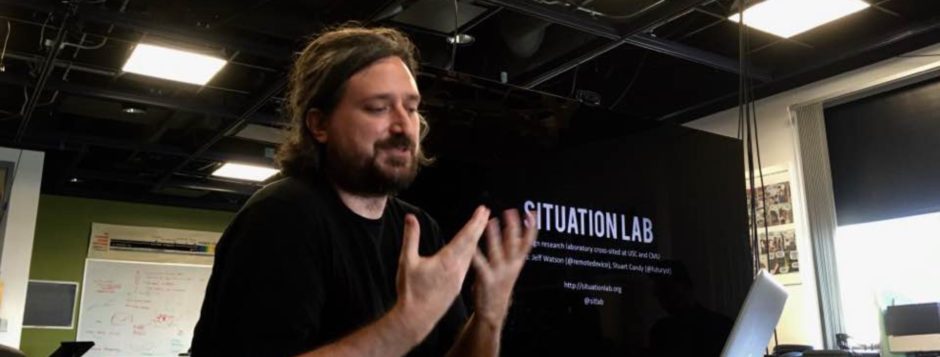
iMAPpenning Slides: Design Research Practice

Slides summarizing my doctoral design and research practice. Presented at “iMAPpening,” a group show featuring my colleagues in Media Arts and Practice at the USC School of Cinematic Arts.
Exam Area III: Interaction Design for Social Media and Pervasive Computing

This post is a part of a series covering my qualifying exam research areas. Scroll to the bottom of this post for…
Exam Area II: History and Theories of Participatory Culture and Art Practice

This post is a part of a series covering my qualifying exam research areas. Scroll to the bottom of this post for…
Exam Area I: New media spaces, or: Alternate Realities, Database Aesthetics, and the Poetics of Space

[This post is a part of a series covering my qualifying exam research areas. Scroll to the bottom of this post…
Building a database of research artifacts

This post is a part of a series covering my qualifying exam research areas. Scroll to the bottom of this post for…
Progress Report: Qualifying Examination

[TL;DR: it’s been a whole lot of reading. Skip down to Qualifying Exam Areas for a description of exactly what…
ARG readings and reflections: an annotated bibliography

This resource contains links to blog posts, conference papers, journal articles, and other texts related to alternate reality gaming.
The amateur operators: notes on early adopters

The hobbyist culture around wireless telegraphy (1906-1912), at once intensely social — as it inherently involved communicating with others — and potentially isolating — as it required technical skills that could only be acquired outside of the flow of ordinary life — bears a striking resemblence to the tinkering subcultures that have attended the rise of home computing, network culture, and social media.
Transmedia and Education: Three Essential Readings
Henry Jenkins’ New Media Literacies class has been a treasure-trove of readings and insights. Three recent articles covered in class struck me as particularly essential for anyone who’s looking to build an understanding of what multimodal communication is and how transmedia relates to education, literacy and literature.
Don’t Worry Vivian, the World is Really Real
I can’t accept that there are many serious people out there who would argue for a completely disembodied, brain-in-a-vat/brain-in-the-machine cyberfuture.
Code and Materiality: Strandbeest and mechanical computing

Johanna Drucker’s discussion of code and materiality (”Code is not an immaterial ideal“) got me thinking about Theo Jansen’s Strandbeest project…
David Golumbia, buzzkiller
I’m excited about all the new forms of politics, art and mischief that participatory technoculture…
Sid Sackson’s Acquire

Since its release in the early 1960s, Acquire has inspired generations of game designers and enthusiasts with its elegant and replayable design. Many game designers, including Ticket to Ride designer Alan R. Moon, cite Acquire as a seminal work in the evoution of tabletop gaming. This post provides designer-centric coverage of the game.
Million Story Building

If a building could talk, what would it say? How would it “feel” about the comings and goings of the people who use it every day? Would it be affected by their moods and desires?
Online, Reading
Reading a novel is an intense experience. Even lowly grocery store thrillers are complex and multimodal textual-linguistic…
Blackboard Kills

Blackboard is an impediment to scholarship, and the sooner universities stop using it, the better.
Polyhedral Dice

When I was a kid, I played a lot of role-playing games. The Marshall brothers, Lucas, Paul and Jonas, and my neighborhood pal, Ryan Sullivan, were my primary playmates in this regard. I played intensively between the ages of about nine and fourteen. After that, rock and roll and movies took over.
Sonar Tonebank

The Sonar Tonebank is a simple electronic music instrument that uses a range sensor to trigger sound samples. Players can create musical soundscapes by moving in front of the range sensor, which maps pitch to distance.
Locative Media and Responsive Environments

This presentation explores the evolution and trajectory of ubiquitous computing technologies that enable designers to embed media artifacts and computational systems in physical space.
Useful Phrases
Useful Phrases uses Markov word/phrase probabilities to generate unique sentences by breaking apart a source text. These sentences are then added to a blog.
Dream_Jrnl

Dream_Jrnl is a generative literature experiment that algorithmically creates evocative and mysterious texts.
IMAP Manifesto

This manifesto describes my intentions, aims and perspectives vis-a-vis my role as a theorist-practitioner both within and beyond the academy.
Transmedia Storytelling and Alternate Reality Games

I prepared this presentation as a primer for non-specialist audiences on the subject of Alternate Reality Games. Includes brief survey of prior art, diagrams illustrating the nature of networked fictions, and references to key scholars/innovators.
Location-Based Ambient Storytelling
A proposal for a directed research project that seeks to identify and implement a range of context and location-based storytelling techniques.
S.T.I.F.L.E.

S.T.I.F.L.E. is an interactive fiction about broken hearts, experimental pharmaceuticals and wandering philosophers.

